


Mountains are a signature feature of almost any image of the landscape of Chile. Those same mountains have played a major role in the cultivation of what could be called Chile’s signature grape: Carménère. During my recent trip to Chile I participated in a masterclass on Carménère conducted by Gonzalo Garcamo, the wine-maker at Viña la Rosa, who has studied and made wine with the variety for many years.
Mountains tend to be in the background of any photo of a Chilean vineyard. The Andes range, extending the whole 5,000 kilometers of the eastern border with Argentina, forms part of the geographical isolation of the country that has helped protect it from pests such as phylloxera.

Cuttings of many French grape varieties, including Carménère, were imported to Chile In the mid 19th century, before phylloxera devastated the vineyards of Europe. At the time Carménère was a common grape in Bordeaux, but it proved to be particularly susceptible to the disease. Very few vines were left to repopulate the vineyards when the technique of grafting to North American rootstock was adopted. The grape had always been problematic in the Bordeaux climate anyway, and farmers tended to replant with more reliable varieties. Chile eventually became the only major grower of the grape anywhere in the world (with a few minor exceptions) and it was grown with its original vinifera rootstock.
The soils of the cultivatable lands of Chile have been created by the mountains. They are the result of millions of years of erosion by wind, precipitation, and sun that has been washed down into the lowlands and river valleys to accumulate in a mish-mash of components. Closer to the rivers the soils are alluvial with lots of sand and gravel and lower levels of nutrients. Up slope are colluvial soils with a lot more clay content. On the edge of the mountains the soils tend to be granitic, with large stones and base rock within easy reach of the vine roots. These types of soils are interlaced in a chaotic way across the land so that a vineyard may have blocks of distinctly different soils. Soil plays a particularly important role in the cultivation of good Carménère.
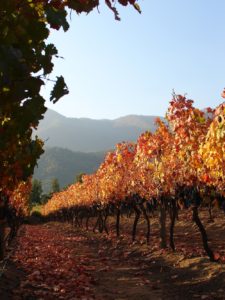
Carménère is a very late ripening variety. It is the last grape to be harvested in Chile, perhaps three weeks after Cabernet Sauvignon. In order for the vines to remain active that late in the season, the soils must have good nutritive qualities. But that’s not enough. Carménère is naturally rich in pyrazines (green aromas and flavours such as bell peppers). Sometimes a touch of green, mint perhaps, can be attractive in a red wine, but too much is off-putting for most tastes. Too much vigour in the vines promotes foliage development, and more green compounds. The soils need to release nutrients slowly over time. Sandy alluvial soils don’t hold water very well, so there tends to be more irrigation, which encourages water-based vigour – undesirable. Soils with water-retaining clay and stones provide for mineral-based, slower-acting vigour.
Restrained vigour over a long growing season has other risks and rewards. Those green flavours need time to be metabolized and reduced to minimal or undetectable levels, which is exactly what the long hot and sunny days of the Chilean growing season allow. Vineyard locations away from the coastal fogs and clouds and closer to the mountains are important. On the flip side, the grape is naturally low in acidity, and too much heat and sun will allow acid levels to plummet below desired standards. The significant difference between daytime and nighttime temperatures, especially where fields can benefit from altitude or cool air descending from the high mountains, is important to let the vines rest, and maintain good levels of acidity.
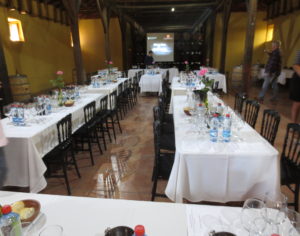
All of these concepts were proven for me, in the glass, during the masterclass, where we tasted wines made from the same harvest, in exactly the same way, with the only difference being in the soils hosting the vines – in adjacent vineyard blocks. We also tasted wine made in the best soil block for several consecutive vintages, and the character varied according to the length and heat of each growing season.
So it turns out that Chile, almost uniquely, has areas that are ideal for the cultivation of Carménère. With what we know today, it is a wonder that it was ever grown in Bordeaux! Not every region of Chile is suitable for the grape, and not every producer is as knowledgeable as Gonzalo in handling the variety. For many years, especially when Carménère was first understood to be different from Merlot, but was still treated like Merlot, most of the resulting wines had a “wild” flavour. This was supposed to be a characteristic, but it is obvious now it was just too much of those nasty pyrazines! You are still likely to find many wines from Chile made from Carménère that is not grown in suitable locations, but you are definitely able to find very well made Carménère now.
Every other characteristic of this grape makes for an interesting and enjoyable wine – a good choice as a signature grape. The wines are deeply coloured and attractive. The tannins, while not abundant, are smooth and round. The flavours of sweet red berries, tasty spices, and hints of tobacco and chocolate are quite enticing. I recommend finding examples of well-grown and well-made Carménère, and I am sure you will love it. Try the Opimian Society (Viña la Rosa is exclusive to the Society in Canada) as well as some higher end wines from the NLC.
Molina, Chile Shipped in a wooden box with each bottle individually wrapped in paper as pictured.
Read More
This year’s NLC spring wine event was a show with mostly modest wines from Canada, United States, Argentina, and Chile. The show was sold out, but the floor was not crowded and it was easy enough to get around and taste. The lines in the show store moved quickly enough. If there was one issue, […]
Read More
Excellent masterclass lesson here for all your readers, Steve. Must have been pure Heaven for you to sit with the appropriate glass in your hand. Thanks so very much for sharing!
Steve, an interesting and concise summary of a whole lot of information in a very organized way. Really found this post helpful in consolidating a lot of the odds and ends of knowledge I had acquired on carmanere over time. Thanks for this. Gerry
Thank you Steve for this excelent review. Regarding exclusivity – just for consistency – Viña La Rosa’s CORNELLANA line is exclusive to the Opimian Society, yet you will find other Viña La Rosa bottlings available through out Canada. Cheers.
[…] in understanding Carmenère and how to make the best wine from the variety (covered in an earlier posting). On that basis, my highest recommendation is for #8960 Cornellana Barrel Reserve Winemaker’s […]