

Earlier this summer I participated in two nights of tastings of Scotch Whisky. I won’t often write about non-wine events and tastings, but spirits which engage and please the senses, such as Scotch, Cognac, Calvados, Spanish brandy, and aged rums, will be exceptions.

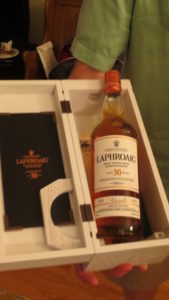
These two tasting occasions were lead by Marcio Ramos, Luxury Brand Ambassador for Beam Suntory Canada. Included in his portfolio are the Scotch labels Laphroaig, Bowmore, and Auchentoshen. The first night was dedicated to Laphroaig, with the selections pictured at the top of this article.
Laphroaig is an Islay Scotch, meaning it is made on the island of that name, in north-western Scotland. Whiskies from Islay are well known for the influence of peat in their aromatic profile, and none more so than Laphroaig. Islay, like much of Scotland and Ireland, has extensive peat bogs which have been used for centuries as sources of fuel.
Peat-fired kilns are used at the end of the malting process to heat and dry the malt before it is ready for fermentation. The malted grain absorbs some of the smoky aromatics which are carried through to the finished product. The amount of smoke contact (ranging as low as “none”) is one of the variables in the distinct taste of Scotch whiskies. Distilleries on Islay have their own dedicated peat bogs, and like vineyard terroir, they display unique qualities. Laphroaig’s bog lies beside the ocean, and captures some of the iodine and other sea flavours in its profile, compared to inland bogs.
The aging process is probably the other main influence on the taste of a whisky. Similar to wine, barrel aging of whisky depends on the wood used, the shape and size of the barrel, and any previous uses of the barrel (either for whisky aging, or for port, sherry, or bourbon). These and other variables give the whisky maker many levers to create and reproduce a unique product behind every label – to be explored and enjoyed on the palate in the same way as good wine.
Our first night explored some of those differences with a mix of locally available Laphroaigs, as well as some that are only available at the distillery, or are quite rare and expensive.
Laphroaig Select: Less peat than the flagship 10 Year Old, fruitiness, hint of orange, honey, vanilla, very smooth heat, sweet.
Triple Wood (Maturation) (oloroso sherry, American oak, quarter cask): Slightly more peat flavour, but also stronger sweetness on the finish, mocha.
Lore (meaning passing of the knowledge): includes some barrels aged up to 27 yrs including Madeira, port, American oak, and sherry barrels. Sweet soft nose, very smooth but peat and heat burst out with iodine in the mouth – brilliant; sort of reluctant nose, but long lingering finish.
Cairdeas (meaning friendship) 200th anniversary, 2015 release: grassy, grainy, oaky, with light peat nose; very smooth nose; light on the palate, with the grass and honey showing, and some mild peat.
Cairdeas, 2017 release, finished in Madeira casks: sweetness on the nose, and maybe some toast, toffee, burst of fruit and sweetness in the mouth and finish.
Cairdeas, 2017 release, cask-strength, quarter-size cask: pale colour, sweet, caramel notes, caramel candy, grassy/coconut oak is evident; loads of heat! Not improved with some water.
Brodir (meaning brotherhood), port cask aged, 16 + years old whiskies in blend: Sweet fruity nose of port with peat tones, chocolate, nice drink, but not enough “Scotch”!
30 Year Old ($1500) 2016 release – 15 years first-fill barrels, 15 yrs second fill – very smooth round aromas, very complex in the mouth, sweet citrus, light toast, totally integrated flavours, fruit preserves! Very smooth, controlled heat, exotic fruits in the flavour. Quite exceptional.

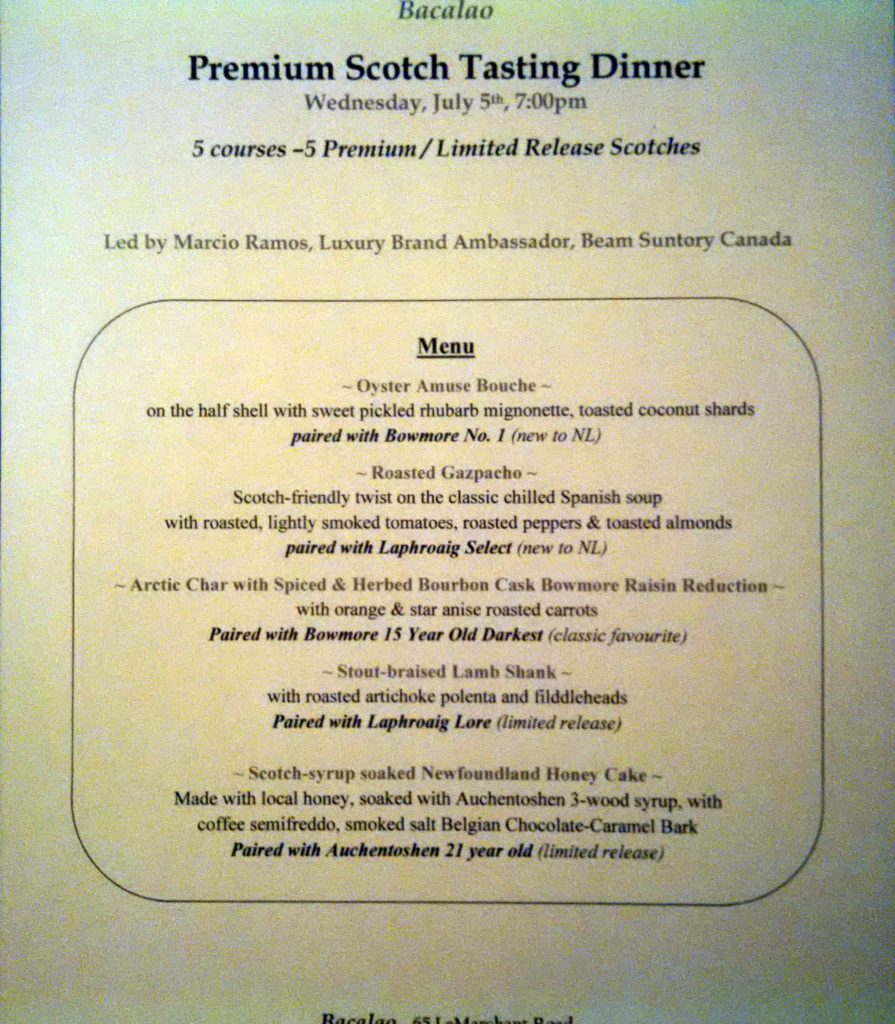
Our second night included Bowmore, another Islay distillery, as well as Auchentoshen, a lowland distillery (with no peat influence), served in comparison with some of the Laphroaig we had enjoyed the previous evening. This tasting was accompanied by a specially developed matching menu at Bacalao.
Bowmore No. 1: preserved citrus fruit aromas, light peat complexity (considered medium peat), smooth in mouth; surprisingly good match with the wood in the whisky picking up the coconut flavours of the first course.
Laphroaig Select: This match picked up the smoky spiciness of the soup and melded with the peat flavours of the whisky.
Bowmore 15 Year Old Darkest: Is dark in colour, more like a middle-dark rum than a whisky, sweet nose (12 years in second use bourbon cask, 3 yrs on oloroso sherry cask), really has an oloroso sherry nose, but very mild peat; peat comes out in the mouth, smooth creamy finish, toffee in the nose – very drinkable. The reduction and star anise flavours of the dish were a great match for the sherry elements of the whisky.
Laphroaig Lore: Preserved fruit, peat complexity, lots of things coming out, sweet highlights, cardamon, some herbal/savoury element, burst of peat and fruitiness, long lingering flavours that go on forever. It’s not so much that the elements complement the food, but that the food accentuates new dimensions of the whisky that were hidden before (and the peat influence seems moderated).
Auchentoshen 21 Year Old: Triple distilled, 81% alcohol can extract a lot from barrels. Sweet honey and flowers, very smooth, good heat, some fire in the nose, toffee, pleasant, but probably not as complex as others. Very rounded and perhaps even creamy. Complemented the honey elements of the dessert.

Are you interested in a Food and Wine Tour of Croatia’s Dalmatian coast in September 2020? ** UPDATE ** Click HERE for a detailed description! Harvey’s Travel organized our custom tour this year, and have asked me to lead a similar excursion next year. The itinerary will be very similar in terms of wineries, locations, […]
Read More
Wonderful to see an evaluation of single malts – an evaluation exceedingly well done.
The Lore was the overall star considering both evenings.