

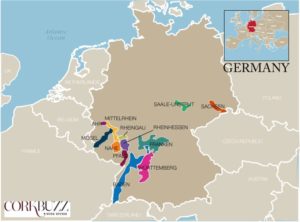
 You probably wrote off white wine from Germany a long time ago when selections were limited to acidic and light plonk that seemed to be aimed at pleasing the (Canadian) sweet tooth. I have since rediscovered the wonders of quality German whites, and if you haven’t yet, you need to give them a second chance.
Germany has the most northerly vineyards in the world, so white wine is a logical result (although production of light red wines has increased to be about 1/3 of total wine output). A combination of cool climate varietals, and site locations which take advantage of sun-ward facing slopes and river micro-climates allows for quality grape growing.
The two main white wine varieties, Riesling and Müller-Thurgau (also called Rivaner), combine with Silvaner, Grauburgunder (Pinot Gris), Weißburgunder (Pinot Blanc), and Kerner to produce most white wines in the country. Riesling represents more than 20% of all German production, and is identified along with Chardonnay as the most noble of the wine grapes.
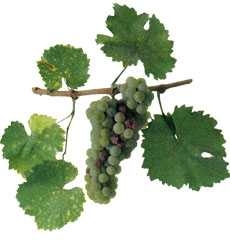
Riesling produces aromatic wines which can show fruit flavours including apple, pear, peach, and citrus (especially lime), as well as flowery aromas. Its naturally high level of acidity suits it well for a variety of styles, such as crisp dry wines, semi-sweet and sweet wines, and sparkling wines. It also allows wines to age for longs periods of time. I have enjoyed exquisite Auslese level semi-sweet wines that were more than 50 years old.
German wines are defined by four quality levels. The lowest two levels are Tafelwein and Landwein which we would not see here. Next is Qualitätswein bestimmter Anbaugebiete (QbA), which includes the well-known Liebraumilch, and would represent the lower priced German wines available here. The highest level, the ones that will restore your appreciation for German whites, is Prädikatswein. Wines are further classified within this quality level based on potential alcohol at harvest as well as production technique.
Ripeness at harvest is always a concern, but even more so in such a northerly region as Germany. One of the chief measures of ripeness is sugar level. Since sugar is converted into alcohol during fermentation, the sugar level represents the potential alcohol at harvest. Sugar levels are classified starting with the minimum allowed: Kabinett, Spätlese, Auslese, Beerenauslese, Trockenbeerenauslese, and Eiswein. Individual berries affected by noble rot are picked to make Beerenauslese wines. Trockenbeerenauslese carries this a step further as the berries will have become raisined before picking. Eiswein corresponds to our Icewine in harvest and pressing.
Sweet grapes do not mean that a wine will be sweet, however! The wine-maker may decide to make the wine in a Trocken (dry) or Halbtrocken (semi-dry) style by allowing fermentation to consume most of the sugars. Some residual sugar is often retained in so-called dry German Reislings to help balance the high acidity and create superlative wines. At the highest levels of sweetness, after late-harvest, raisining, or freezing, too much alcohol would be produced for a well-balanced wine, so these styles are almost always sweet, and rival the best sweet wines of the world.
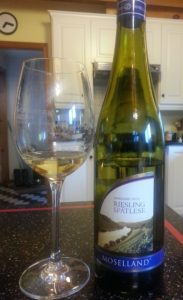
This week’s wine is the Moselland Riesling Spätlese 2015 (NLC $17.76) from the Mosel region of Germany, which we paired with some mildly spiced Indian cuisine. The primary aroma was lime citrus, with accents from soft fruits and fresh herbs. Good acidity was indeed balanced with some evident sweetness which matched well with the sauces of our various dishes. Score: 14/Good.

November 29, 2018
Argentina, Australia, Canada, Chile, France, Germany, Italy, New Zealand, Portugal, South Africa, Spain, USA
I spent a lot more time at this year’s wine show chatting with fellow tasters about the wines and old times than usual! As a result, I ended up tasting a smaller selection than normal for this year’s report. No doubt I have missed out on some great wines and you will therefore not see […]
Read More
October 7, 2018
Canada, France, Germany, Opimian Society, South Africa, Spain
Vancouver Island Visit This was my fourth visit to Vancouver Island and its wineries, but there were still a couple of new places to try out. And not just for wine as we will see. Near Duncan we found Enrico Winery which has been in operation for a dozen years and produces about 3500 cases […]
Read More
Do the German vintners still practice ‘suss-reserve’?
My understanding is the use of suss-reserve is in decline. Suss-reserve is stabilized, unfermented grape juice. It is used post-fermentation to add some sweetness to a wine to balance acidity and provide more roundness. (Grapes such as Riesling in a cool climate are wonderful at retaining acidity.) It also has the effect of lowering alcohol levels. Other methods have gained favour, such as adding grape must (pre-fermentation) so that there is some residual sugar, or stopping fermentation early to retain residual sugars. Both these methods are less expensive than suss-reserve, but do not have exactly the same effect on the end wine. Besides process changes, dry wines are gaining preference in the market and reducing the use of sus-reserve.