

I started last week’s report on the “Tasting of Wines from Italy” event mentioning the wide diversity of grape varieties from Italy. I am always interested to taste a varietal that is new to me, and also to taste a known varietal from a new region/terroir.
With a sample of one it is not possible to know if you are tasting a good example of the new grape, or one that properly represents its best characteristics – but it’s a start. At least I can say that the new wines I tasted at the show were all good wines, ranging from pleasant to exceptional.
Phylloxera hit the vineyards of Italy very hard, like most of the rest of Europe. When farmers replanted, they often chose the more common varietals from France and Italy, rather than their original local varieties. They also tended to aim at high yielding varieties, for purely economic reasons. In today’s market, however, there is an increased demand for quality over quantity, and perhaps also interest in something “different”. Lower yielding varieties now have some advantages.
In Italy this development has resulted in many old varieties being rescued from obscurity and brought back into commercial production. For someone like me, the results are wonderful!
The varietals that were new to me included:
Many other varieties I have sampled before, but are almost never available locally for regular consumption:
Here are the remaining suppliers I tasted at the event, and their wines which deserved to be noted.
Castello di Neive and Olivero Mario are from the Piedmont region which is known as the home of the wine of kings, Barolo, made from the Nebbiolo grape. Castello di Neive had one white wine from the Arneis variety , the Langhe Arneis DOC 2015 which was deliciously tart and light, and highly quaffable. Their Barbera d’Alba DOC 2014 was soft with ripe fruit flavours even though it showed some smooth tannins. They brought the Piemonte DOC Albarossa 2014 which showed delicious fresh red fruit aroma balanced with acidity and some tannin. I finished with two Nebbiolo wines, the Barbaresco DOCG 2013, and the single vineyard Barbaresco DOCG Santo Stefano 2013. Black fruit and tea, with young tannins were clearly present in both wines, but the San Stefano had an extra element of wonderful complexity on the tongue.
In a place where Nebbiolo is the most famous variety, I was most impressed with Olivero Mario’s Barbera d’Alba DOC Campii Raudii 2013 which was a huge wine for this varietal – loaded with fruit but supported with tannins and some considerable oak aging. All of the wines from this producer earned high marks in my notes, as all of them showed intense flavours, strong varietal characteristics, excellent structure, and compelling complexity: Barolo DOCG Bricco Rocca 2012, Langhe DOC Nebbiolo 2013, Dolcetto d’Alba DOC Buschet 2014, and Langhe DOC Arneis 2015.
Marche and Umbria are not so famous for their wines, even though they deserve to be! That’s a bonus for us in pricing. Marche, in particular its southern province of Ascoli Piceno, is one of my favourite places. Monte Schiavo was showing two fabulous whites: Pallio di San Floriano Verdicchio dei Castelli di Jesi DOC Classico Superiore 2015, and Le Giuncare Castelli di Jesi Verdicchio Riserva DOCG Classico 2013. Both were intense with full flavour and structure, with the DOCG wine having the edge. The Sassaiolo Rosso Piceno DOC 2013 is a blend of 60% Montepulciano and 40% Sangiovese and is simply a tremendous value for an expressive, structured red wine. If you have never tried a wine made from the Lacrima variety, you should start with their Marzaiola Lacrima di Morro d’Alba DOC 2015 with its amazing aromas of violets and roses and medium-light body – an intriguing wine which challenges you for a food pairing.
My only taste of the Maceratino variety was at the Saputi booth and I found their Colli Maceratesi DOC Ribona 2015 to be deliciously fruity with juicy acidity.
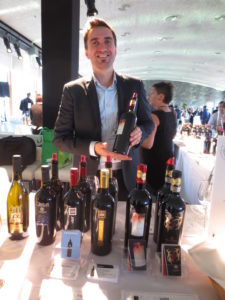
I had visited Velenosi Vini a few years ago in Ascoli Piceno and was familiar with their offerings. My favourites shown at this this event were the Paserina 2015, Chardonnay 2015, Falerio DOC Villa Angela Pecorino 2015, Rosso Piceno DOC Superiore Brecciarolo Gold 2014 (great value!), and the Rosso Piceno DOC Superiore Roggio del Filare 2011.
The signature red wine grape of Umbria is the Sagrantino – virtually unknown outside of its territory because of low production. The varietal is capable of producing wines which are rich in tannins, intensely dark-purple in colour, and with red fruit flavours accented with spice and earth. These wines can (and should) age for decades and can compare favourably with other great wines of character. The DOCG wines must be 100% Sagrantino, while the Rosso DOC wines are blends which are mainly Sangiovese with some Sagrantino. The Consorzio Tutela Vini Montefalco is a group of small wine suppliers from Umbria who have banded together for marketing purposes. I tasted wine from three of the suppliers. My top picks were: Montefalco Sagrantino DOCG 2011 Le Cimate, Montefalco Sagrantino DOCG 2012 Perticaia, Montefalco Sagrantino DOCG 2010 Scacciadiavoli, and Montefalco Rosso DOC 2013 Perticaia.
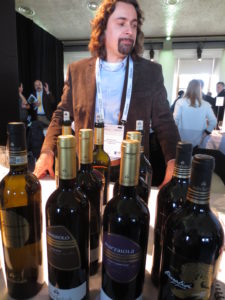
You can’t do Italian wines without touching on Tuscany but there is only so much time! San Fabiano Calcinaia was my only Tuscan producer. My picks from this producer were: Toscana IGT Cerviolo Bianco 2015 (50% Chardonnay, 50% Sauvignon Blanc); Toscana IGT Cerviolo Rosso 2013 (30% Petit Verdot, 30% Cabernet Sauvignon, 40% Sangiovese); Chianti Classico DOCG San Fabiano Calcinaia 2014; and the Chianti Classico Gran Selezione DOCG 2013.
This was a wonderful tasting event … I only wish there were there was more time available!
Future Postings
The next few postings will be about Chile as I visit a host of wineries next week.
Steve Delaney
November 14, 2016
Italy
No Comment