
The Luberon you say? You likely have heard of the French wine regions of the Rhône and Provence. The Luberon AOC is a bit of both as it is located in the civil administrative region of Provence-Alpes-Côte d’Azur, but is included with the other AOC wines of the Rhône such as Hermitage and Châteauneuf-du-Pape.

AOC Luberon is located within a larger area, the Parc Naturel Régional de Luberon, a rough area of hills and valleys on the edge of the Alps, looking down towards the Mediterranean coast of France. Head south-eastly from Avignon, or north from Marseilles and the rising terrain becomes lumpy and green, and the winding roads begin to narrow. This is a land of small villages, many of them situated on hill-tops, the remnants of fortified towns where ancient tribal kings once ruled their tiny territories. The Parc encompasses both an interesting geological and natural heritage as well as human heritage.

Evidence of human occupation in Provence goes back hundreds of thousands of years and it would have been one of the earliest areas of modern human settlement in Europe. In keeping with that history is the agricultural heritage of wine making. It may have started with the local tribes, but certainly was developed as first the Greeks founded Marseilles (~600 BC) and settled along the coast, and then the Romans incorporated the territory as the first part of Rome beyond the Alps.
Vines in the Luberon have advantages over the coastal and Rhône valley appellations as they still enjoy lots of warmth and sun from their Mediterranean exposure, but with the cooling aspects of elevation. Cooler nights help retain acidity in the grapes and allow the plants to “rest”. The region enjoys good levels of precipitation which falls mainly in the winter, quite often as snow!
The grape varieties of the area are similar to elsewhere in the Rhône and Provence – for example Syrah, Grenache, and Carignan for the reds, and Bourboulenc and Grenache Blanc for the whites. Rosés are made from any of the reds, with up to 20% allowed from the white varietals.
If you hadn’t heard of the Luberon AOC before it really is no surprise. Wines from this area and Provence in general have not been particularly noteworthy, with the exception of wines from Bandol AOC (red wines based on the Mourvèdre grape) and, of course, Provence rosé. This is changing as economic development in the rural parts of Provence has seen an emphasis on artisanal crafts and production (in addition to tourism) and this is also evident in wine-making. Wineries such as Château la Canorgue have established international reputations based on the natural advantages of their terroir.
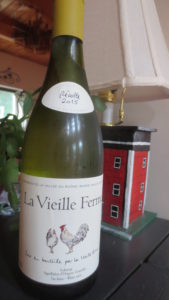
There is one wine from the Luberon at the NLC, and it is worth giving a try. The La Vieille Ferme Cotes du Luberon Blanc 2015 (NLC $16.14) is made from Bourboulenc, Grenache Blanc, Ugni Blanc, and Vermentino. A small part of the blend is fermented in oak barrels, rather than stainless steel, adding some depth to the flavours, but you likely won’t notice any oak influence. Stone fruit aromas such as pear and peach were most evident, accented with a touch of white flowers. The wine was lovely and fresh in the mouth, with medium body. This wine is a good accompaniment for simple meals; it was lovely with our salmon. Score 15.5/Very Good.

We enjoyed our last virtual tasting so much we had to do it again – a great excuse to pull out some wines a little more special than normal, particularly the sweets, which are rare without (real) company. And then we combine this with a chat about the wines (and other things) with our wine […]
Read More
Steve Delaney
July 11, 2016
France
No Comment