

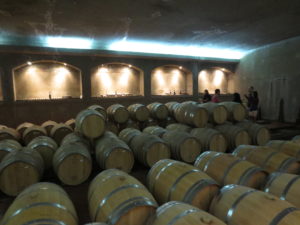
Aging wine in oak barrels is an important part of wine-making. Gaining an understanding of the role of oak in the taste (and cost) of wines was the goal of a morning I spent at Tonnellerie Nadalié in Chile last November during our Opimian trip.
Oak is preferred for wine barrels over other woods because it is water-tight yet sufficiently porous to interact with wine, and it imparts beneficial, as opposed to off-putting, aromas and other characteristics. Oak has varieties and terroir just like wine, although to a lesser extent. Several species of oak grow in the forests of western and central North America, as well as in France, Croatia, Hungary, and Russia. These species vary in the tightness of their pores and the particular type and quantity of aromatic compounds in the wood.
Even within the same species, there are differences from forest to forest, which is most evident in barrels from one of the five main French forests. The barrel-making process itself introduces differences, the most important being the amount of “toasting” performed on the interior. Some aromatics come from the wood, such as coconut, cloves, and vanilla, while others come from the toasting process, such as caramel, sweetness, smokiness, etc.
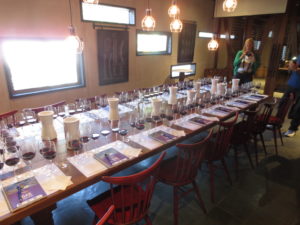
In our tasting (as pictured) we were served six wines which were prepared identically except for the choice of French oak used in the aging process. I am not sure what was more interesting: that the different oaks subtly changed the taste of the wine, or that humans’ sense of taste is so discerning that even those small differences were quite noticeable by all participants. It was even possible, knowing that some oaks would be more tannic or spicy than others to guess which wines used which oak! The bottom line is that the choice of barrel made by the wine-maker has a direct and noticeable affect on the final wine product.
Oak barrels are expensive (more on that below) so it makes sense to reuse them – a common practice. The contribution a barrel makes to a wine declines with multiple uses. By the time a barrel has been used four or five times it has little left to give to the wine. (It might see further life in the aging of spirits.) Only the biggest wines will be aged solely in first-use barrels – more often there is a combination of first, second, and third year and more barrels used to impart just the right amount of aromatics to complement the wine.
Aging in barrels also has the purpose of exposing the wine to trace amounts of oxygen over time, working to soften tannins. Barrel size affects the surface area exposed to the wine inside. The volume of a barrel increases faster than its interior surface area, so that bigger barrels have less wood contact with the wine inside, and therefore lesser or slower impact on the aromatics. Some of the wood tannins from the barrels also act to protect the wine from oxidation.
Making a Barrel
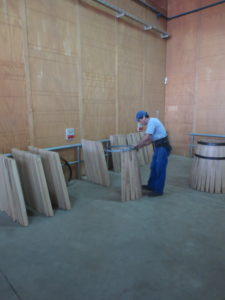
Tonnellerie Nadalié is a French company with an operation in Chile making barrels from French oak. The oak comes from the managed French forests where there is an annual auction process for the trees to be harvested. Trees are harvested when they are between 200 and 400 years old, with the older trees commanding higher prices.
Once a tree is cut down it must be allowed to dry for three years before being cut to length and split into staves. The staves then get another two years of drying before they will be made into barrels.
Shaping barrels (coopering) is an old craft that has all but disappeared for other uses, but is essential to the wine trade. Although there are many machines involved in the process, it remains a relatively labour-intensive activity.
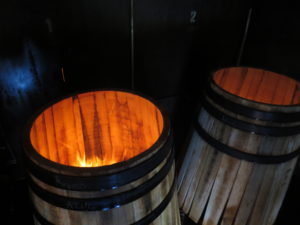
Tonnellerie Nadalié receives shipments of prepared staves from France from which it assembles the barrels. First the staves are aligned in a round shape (called a rose) using an iron hoop. The assemblage is exposed to water and heat to allow the staves to be deformed into a barrel shape. Then the barrel undergoes toasting – basically setting a fire inside the barrel and charring the insides. There are more than a dozen shades of toast – the level of toast affects the aromatics the wine will draw from the barrel.
The ends of the staves need to be shaped to accept barrel ends, and those ends are then inserted. The barrel is tested for leakage, and may need adjustment. The outside of the barrel is smoothed and sanded, and the barrels are labelled to indicate various technical measurements as well as the barrel maker, and perhaps the winery that is buying the barrel.
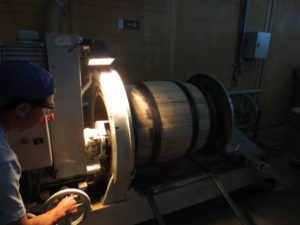
French oak barrels can cost up to $1000 each, and that’s no surprise when you understand the processes involved. A standard barrel holds 300 bottles of wine. If each barrel is used for four years, that’s 1200 bottles. So using French oak adds at least $1 to the cost of a bottle of wine, which is then multiplied by taxes, etc before it reaches the end consumer.
Other oak sources can be a little cheaper, based mainly on the cost of the trees. Using oak barrels for fermenting and aging wines is therefore reserved for higher quality and premium wines. Only such wines can command sufficient price in the market to cover such costs. But lesser wines can still get some oak benefits. The industry also makes products such as staves, chips, and “tea-bags” that can be placed in aging vats to contribute some of the benefits of wood to such wines.
Some Steps in the Barrel-Making Process

We enjoyed our last virtual tasting so much we had to do it again – a great excuse to pull out some wines a little more special than normal, particularly the sweets, which are rare without (real) company. And then we combine this with a chat about the wines (and other things) with our wine […]
Read More
We had been interested in setting a date for a dinner and tasting with our two close-by friends, but it was derailed by the recent omicron surge! Instead, we arranged to dine separately, but using the same wine selection, and then connect on Zoom over the dessert wine and discuss the wines, and the match […]
Read More
Thanks so very much for passing along this masterclass Steve!