

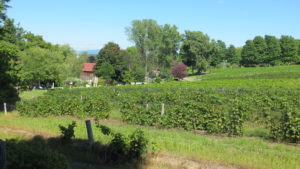
Domaine Côtes d’Ardoise is Québec’s oldest operational vineyard, located in the Eastern Townships near Dunham. Some of the vines are 35 years old, planted by the original owner, Christian Barthomeuf, in 1981. At that time there were no provisions in Québec legislation for either producing or selling wine commercially – Monsieur Barthomeuf was literally breaking new ground.
Although he had proven you could make good wine in Québec, Barthomeuf found that getting good prices for it was another story. He sold the winery to other interests and moved on to his next project. In 1990 he produced the world’s first ice cider, based on the same principles used to make ice wine – crushing frozen fruit and fermentation of the resulting small amounts of concentrated juice. He had established a new drink, and Québec’s apple producers must be ever thankful (as well as the consumer!).
Apple and cider production seem to be closely linked with vineyards in the Eastern Townships. Three of the four wineries we visited grew both fruit, and the vineyards mostly had replaced old apple orchards. Where grape and wine production might be a bit chancy, it seems apple and cider production is much more reliable in the area, helping secure the bottom line.
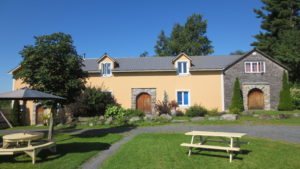
Ever the innovator, Barthomeuf moved on to establish Clos Saragnat next to the border with Vermont. During our visit he described how he had developed his own principles for the natural production of apples, pears, and grapes – what can only be described as a unique twist on the organic production movement. Tramping about the local woods he observed how bushes and trees grew in the wild, as well as the natural interactions with animals (and their “leavngs”) and insects. As a result he has broken down his acreage into small plots. Some of these plots host apple or pear trees, others vines, and still others are “humid” areas. All the plots are separated by hedges of bushes and trees left to grow wild. The humid areas support a wide variety of insect and animal life. Barthomeuf feels that his approach allows for a balance of natural forces and no intervention, either chemical or mechanical, is needed to ensure a good harvest.
The trees and vines he planted were left to fend for themselves for water, nutrients, and protection from insects and disease. Those that survived were obviously the most fit for the area. Rather than training his vines horizontally along wires, he has them growing vertically up posts, as the original wild vines would have on the trunks of trees in ancient forests. His approach seems to go against hundreds of years of farming development, but you can’t argue with the easily apparent health of the trees and vines, and the pears, apples, and grapes. His approach avoids a lot of expensive farm inputs in the form of fertilizers (natural or otherwise) and pesticides, and even reduces labour.
He also believes in a very natural approach to wine production. Only the natural yeast of the farm are involved, and they work very slowly in the cooler climate of his location. His ice cider and ice wine were fermenting for two years! The ice cider had a distinct cooked apple pie nose, and tasted like the spicy, sweet nectar that might run out of your slice of apple pie – Score 16.5/Very Good. The ice wine was made from Vidal and was just as impressive with burnt orange and honey flavours and aromas – Score 16.5/Very Good.

Back at busy and bustling Côtes d’Ardoise, we tasted a range of five wines. Le Maredoise is a white wine made from Seyval Blanc showing pineapple aromas. It was suprisingly tasty with a touch of sweet fruit – Score 14/Good. Charmes & Delice is a rosé from Seyval Noir and Frontenac Gris showing a strawberry candy nose but was nicely dry with good acidity; quite light and a bit tart at the finish – Score 13.5/Good.
We had two reds which showed the weakness in this category in the region – both were quite light, tart, and short in the finish. The Haute-Combe made from Gamay, de Chaunac, and Chelloy showed plum and red currant on the nose and might have gone well with a pasta dish. I found the Côte d’Ardoise made from Marechal Foch and Lucie Kuhlmann to be a bit green and wild. We finished with an ice cider which had exquisite cooked, spicy, apple pie aromas, nice acidity and texture, and flavours of honey and apricots in the mouth – Score 16/Very Good.
This brief tour of Québec’s wine and cider industry was quite an eye-opener for me.
Quick Notes:
The NLC’s Wine Show is fast approaching at the end of the month. Besides the main event, many local agents are hosting tastings and dinners, some with reps from the wineries, showing off what will be on display – keep an eye out!

We had been interested in setting a date for a dinner and tasting with our two close-by friends, but it was derailed by the recent omicron surge! Instead, we arranged to dine separately, but using the same wine selection, and then connect on Zoom over the dessert wine and discuss the wines, and the match […]
Read More
Steve Delaney
September 7, 2016
Canada
No Comment