

Wine tasting doesn’t get much better than this wonderful week, which included two dinners with special wines. Most of the globe was covered, some of the special places in particular, as well as many styles and grape varieties! Let’s get started.
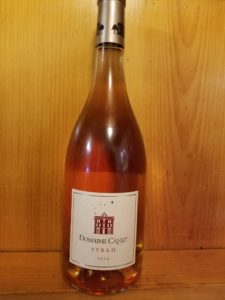
Some Pacific salmon for Sunday dinner was accompanied by Domaine Canet Syrah Rosé 2010, IGP Pays d’Oc. This Opimian wine was starting to show some age in the flavour. The Syrah, however, provided some depth in its bramble fruit bouquet and was quite pleasant.
Other supper wines during the week included a Pérez Barquero Viña Amalia 2016, DO Montilla-Moriles from Andalusia in Spain. This Opimian sourced wine featured the Pedro Ximenes grape variety, with a touch of Verdejo and Moscato. Pedro Ximenes is used in this DO to produce fortified wines using the same techniques as in Jerez (Sherry), but in this case we had a regular dry wine with light body and fresh flavours.
There were two more Opimian wines, one from Portugal and one from Chile. The Portuguese white wine was from Vinho Regional Tejo and was a blend of the Arinto, Malvasia, and Fernão Pires varieties – Encosta do Sobral Selectien Branco 2016.
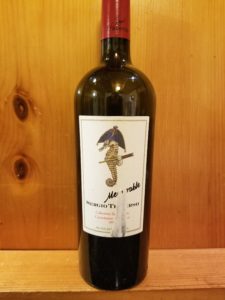
From Chile we had the Sergio Traverso Memorable 2005, Alto Valle del Rio Claro – a blend of Cabernet Sauvignon, Carmenere, and Merlot. At a dozen years old this was a smooth, big wine – quite delicious!
Valpolicella is a relatively well known Italian wine style based on the Corvina, Rondinella, and Molinara grape varieties from the Veneto wine region. It is usually a lighter bodied wine with expressive cherry fruit bouquet. Amarone has become well known in the past few decades as a heavier, richer red wine from the region. It is made by partially drying the same grape varieties before pressing. This both concentrates the flavour components and changes them.
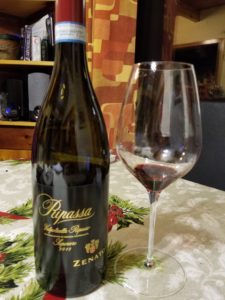
When you take a standard Valpolicella wine and leave it in contact with the pomace (skins and pits) left over from Amarone production, you get a ripasso wine such as the Zenato Valpolicella Ripasso Superiore 2013, DOC (NLC $30.99). The ripasso technique increases the depth of colour and flavour of the resulting wine. Our wine was rich with ripe bramble fruit, almost the flavour that partridgeberries take on when you pick them in the spring after they have over-wintered. Score: 16.5/Very Good.
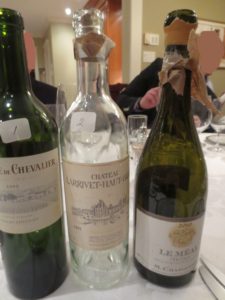
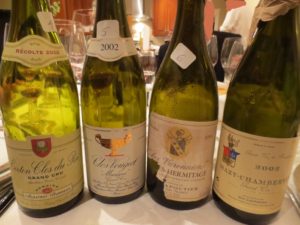
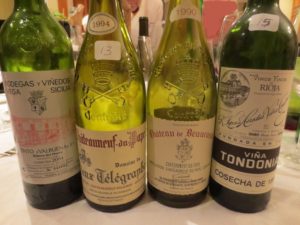
The wine list for the two dinner parties featured some spectacular wines – classified growths from Bordeaux, grand crus from Burgundy, and well known labels from Spain, the Rhône, and elsewhere.

All the wines are worthy of comment, in their own right, but I will simply mention the ones that had the most impact on me. The two reds, Clos des Menuts 1995, Saint-Emilion Grand Cru, and Guy Castagnier Patricières-Chambertin Grand Cru 1998 (Burgundy) were the main features of the first dinner.
At the second dinner, with a larger group, there were several favourites, but I will just mention the Château Cheval Blanc 1976, the Clos Vougeot Musigny 2002, and the Taylor Fladgate 1985 as my top three picks!



We enjoyed our last virtual tasting so much we had to do it again – a great excuse to pull out some wines a little more special than normal, particularly the sweets, which are rare without (real) company. And then we combine this with a chat about the wines (and other things) with our wine […]
Read More
We had been interested in setting a date for a dinner and tasting with our two close-by friends, but it was derailed by the recent omicron surge! Instead, we arranged to dine separately, but using the same wine selection, and then connect on Zoom over the dessert wine and discuss the wines, and the match […]
Read More
Steve Delaney
January 21, 2018
Australia, Chile, France, Italy, New Zealand, Portugal, South Africa, Spain
No Comment